Over the years, students in Applied Energy Laboratory have completed a wide range of innovative and high-quality projects. Many of these projects have been showcased in academic conferences and final-year exhibitions, reflecting the creativity, technical skills, and problem-solving abilities of our students:
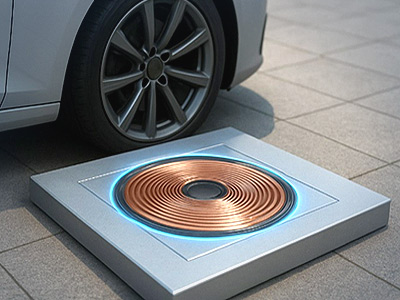
Modeling and Control Design of High Energy, Power Bursting Wireless Transfer Systems
Supervisor(s):
Ohad Akler
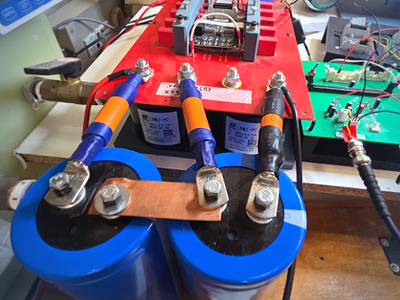
Our research focuses on advanced modeling and control of nonlinear resonant inverter systems for pulsed-power applications. The system under consideration is a capacitor-powered half-bridge inverter driving a series RLC load with time-varying parameters. Unlike conventional steady-state systems, this configuration operates under short, high-power bursts, during which the load resistance and inductance can change rapidly. The inverter is supplied by pre-charged DC capacitors that discharge their stored energy into the dynamic load during each pulse. This arrangement is particularly challenging because the system does not reach steady state within a single pulse, making classical phasor analysis invalid. To address this, we develop and validate nonlinear reduced-order envelope models that capture the large-signal amplitude and phase dynamics without resorting to linearization. Building on this foundation, we propose a nonlinear control strategy, enabling the design of a practical linear feedback controller capable of regulating resonant frequency and energy transfer in real time.
more info
Application of an Active DC Link to Commercial LED Driver
Supervisor(s):
Pavel Strajnikov
2025
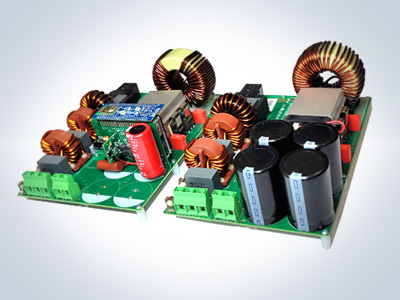
This paper explores practical implementation of an active decoupling device integrated into a commercial 120-watt LED driver. The device, employing a series-stacked buffer (SSB)–active DC link, replaces the traditional DC-bus electrolytic capacitor. Utilizing an auxiliary total capacitance smaller than a third of the original capacitance, the device effectively emulates the low-frequency characteristics of a
significantly larger capacitance.
The central objective of this study is to showcase the feasibility of incorporating small electrolytic auxiliary capacitors instead of ceramic class two capacitors and to design a high-power-density, compact electronic board capable of effectively replacing a large electrolytic capacitor. It is essential to note that the objective was not to optimize the physical size or cost of the proposed device but to emphasize its ability to operate identically or even improve the performance of a commercial product.
more info
Optimal Load Type for Passive Magnetic Energy Harvesters
Supervisor(s):
Moshe Shvartsas
2025
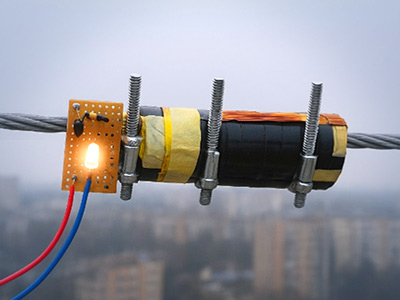
MPL comparison of a passive magnetic energy harvesting under voltage-type and resistance-type loads was carried out in the brief. It was demonstrated (both analytically and experimentally) that voltagetype loading should be favored if harvested power maximization under a wide range of primary current magnitudes is targeted.
more info
Design of Frequency Bounded IWPT Systems under Sub-Resonant Control for Improved Misalignment Tolerance
Supervisor(s):
Andrey Vulfovich
2024
There exist numerous cases in which wireless power transfer (WPT) systems are required to operate with varying geometrical positioning (vertical distance, misalignment) between the transmitter and receiver sides, creating the need for robust systems that can operate over a range of coupling coefficients. Subresonant frequency controlled inductive WPT link (IWPTL), utilizing frequency variation to control system output, has proven to be an effective solution to this problem, however, frequency constraints introduced in practical applications such as the SAEJ2954 electrical vehicle (EV) charging protocol naturally limit the coupling variance range for which such a system can correctly operate.
This paper introduces clear and concise guidelines for a modified sub-resonant controlled series-series (SS) compensated IWPTL with improved coupling tolerance under frequency constraints.
more info